
Switching to renewable energy is a big step for any business. This guide offers a comprehensive roadmap for your journey. It helps you upgrade your energy system efficiently and meet industry standards.
We’ll cover every important step, from site studies to monitoring performance. Adopting a sustainable energy strategy is wise and cost-effective. It cuts down on costs and shows your commitment to the planet.
If you’re starting or ready to begin, this guide has what you need. We’ll go through the key steps to power your place with clean energy for years.
Conducting a Comprehensive Site Feasibility Study
A successful commercial solar panel installation starts long before the first bolt is tightened. Working with commercial solar installation experts helps identify early challenges. This ensures the system design fits the building and meets financial goals.
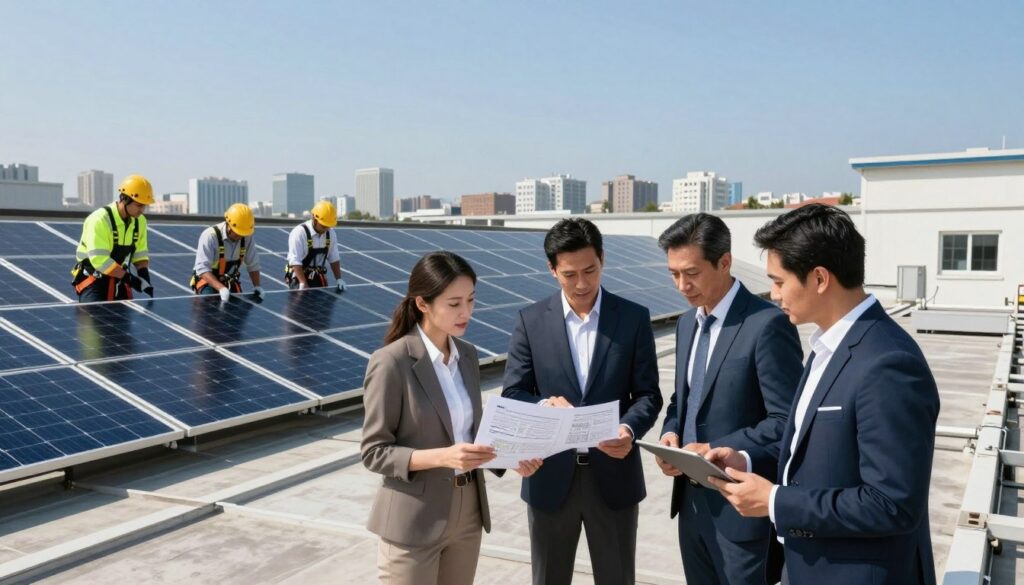
Evaluating Roof Structural Integrity and Orientation
The roof is key for most solar arrays. Its strength is a top concern. Engineers check if the roof can handle the weight of solar panels for twenty years.
They also look for signs of damage or if the roof needs strengthening. The roof’s direction and tilt affect how much energy it can produce. In the U.S., south-facing roofs are best, but east-west can also work well. Experts use software to predict sun exposure and optimize energy output.
Analyzing Energy Consumption Patterns and Load Profiles
Understanding energy use is vital for the right system size. Experts review utility bills and data to create a detailed load profile. This helps figure out how many panels are needed to meet peak demand without overdoing it.
“Proper data analysis is the difference between a system that merely functions and one that truly optimizes your bottom line.”
— Industry Energy Consultant
Assessing Local Zoning Laws and Environmental Constraints
Understanding local laws is key to avoid delays. Zoning rules set limits on height, distance, and appearance of solar arrays. Commercial solar installation experts check these laws to ensure compliance.
Environmental rules, like protecting habitats or preserving history, also matter. Finding out about these early helps adjust designs or get needed permits. Here’s what a standard feasibility assessment includes.
| Assessment Category | Primary Focus | Impact Level |
| Structural | Roof load capacity | High |
| Electrical | Load profile analysis | High |
| Regulatory | Zoning and permits | Medium |
| Environmental | Site constraints | Low |
Navigating Financial Planning and Federal Incentives
Starting with commercial solar energy solutions means understanding your finances well. This way, your solar project becomes a valuable asset. It helps improve your company’s financial health.

Team up with top commercial solar installation services to find out about special incentives. A good financial plan makes sure every dollar spent helps your business save money and become energy-independent.
Understanding the Investment Tax Credit (ITC) for Businesses
The Investment Tax Credit (ITC) is a big help for businesses. It lets you claim a big part of your solar project costs as a tax credit. This can greatly reduce your tax bill.
- Direct Reduction: The credit lowers your tax bill dollar-for-dollar.
- Project Scope: It covers equipment, labor, and installation costs.
- Carry-Forward Options: Unused credits can often be carried forward to future tax years.
Exploring Accelerated Depreciation and MACRS Benefits
There’s more than just tax credits. The Modified Accelerated Cost Recovery System (MACRS) lets you write off solar costs faster. This means you can save money sooner.
Using MACRS well means you can lower your taxes early on. This gives you money to spend on other important business areas.
Calculating Return on Investment and Payback Periods
To convince others about solar, you need to show the benefits. This includes the return on investment (ROI) and how long it takes to pay back. These numbers show how soon you’ll start saving money.
When figuring these out, think about a few things:
- Annual Energy Savings: The drop in utility bills over time.
- System Longevity: The panels’ expected 25-plus year life.
- Maintenance Costs: The costs for upkeep and checks.
Working with top commercial solar installation services gives you access to tools for accurate predictions. These are key to showing that your commercial solar energy solutions will keep bringing in money for years.
Selecting Professional Solar Panel Installers
Finding a good contractor is key when planning your energy project. Solar panel installation services of high quality are vital for your system’s long-term efficiency. It’s important to carefully choose your installer to safeguard your investment and avoid future problems.
Vetting Credentials and NABCEP Certification
Look for certifications that show the installer’s skill. The North American Board of Certified Energy Practitioners (NABCEP) is top in the US for professional solar panel installers.
NABCEP certification means the team knows the latest safety and electrical codes. Make sure the company has current licenses and insurance before you sign anything.
Reviewing Past Commercial Project Portfolios
A good commercial solar panel company will show you their past work. You want to see projects similar to yours.
Ask for references from businesses like yours. Looking at these case studies helps you see if the contractor can handle your specific needs.
Comparing Quotes and Service Level Agreements
When you find the best commercial solar panel installers, ask for detailed quotes. A clear bid should list costs for hardware, labor, and permits.
Also, check the Service Level Agreement (SLA). A good SLA outlines maintenance, repair times, and performance promises. Talking about these terms early protects your interests for years to come.
Executing the Commercial Solar Panel Installation
Turning plans into a working energy system is a detailed process. This step moves from design to real-world setup of a commercial solar panel installation. It’s all about following safety rules and engineering plans closely.
Preparing the Site and Staging Equipment
Before starting, the area needs to be ready. Workers set up a safe area to keep everyone and the building safe. They also arrange heavy equipment to avoid damage and risks.
Good planning helps avoid delays in the commercial solar system installation. Teams sort out parts in specific areas to make work flow better. This setup is key for a safe and efficient building site.
Installing Racking Systems and Mounting Hardware
The racking system is the heart of the solar array. Installers must secure it to handle wind and snow. Using top-notch hardware keeps the system stable for years.
“The integrity of the racking system is the single most important factor in the long-term durability of a solar array.”
— Industry Engineering Standard
Technicians check that all connections meet the engineering report. This step stops leaks and prepares the array for weather. Below is a table showing how to mount on different roofs.
| Roof Type | Mounting Method | Load Distribution |
| Flat Concrete | Ballasted System | High |
| Metal Standing Seam | Clamped Attachment | Low |
| Asphalt Shingle | Flash-based Mounts | Moderate |
Securing Solar Modules and Managing Cabling
After the racking is set, the solar panels go on. Each panel is attached as the maker says to avoid damage. They also make sure there’s enough space for the panels to move with temperature changes.
Handling electrical cables is also key for a top-notch commercial solar system installation. Workers use special conduits and clips to keep wires safe and neat. This careful work stops future problems and keeps the system running well.
A successful commercial solar panel installation needs these last steps. By making sure every connection is tight and cables are managed well, the team creates a strong and efficient energy source. This careful work protects your investment and boosts energy output over time.
Managing Permitting and Regulatory Compliance
Professional solar panel installers face a maze of local, state, and federal rules to start a project. Getting these right avoids expensive legal hold-ups and keeps your system legal. Attention to detail is key to a smooth project, not one stuck in red tape.
Submitting Engineering Plans to Local Authorities
The first step is to send detailed engineering plans to your local building department. These plans must show the system’s structure and electrical setup. Accurate documentation is critical, as officials check these to make sure they follow all rules and safety standards.
Coordinating with Utility Providers for Interconnection
Getting a grid interconnection agreement is essential for commercial solar projects. This involves working with your local utility to check if the grid can handle your system’s energy. You need to give technical details that show your equipment meets the utility’s safety and performance needs.
Ensuring Compliance with National Electrical Code (NEC) Standards
Safety is the top concern in building a big solar array. Following the National Electrical Code (NEC) ensures your wiring, grounding, and safety devices work right. This protects your investment and keeps your electrical system reliable for years.
Integrating Electrical Systems and Grid Connection
The transition from raw solar energy to usable facility power happens during the electrical integration phase. This critical stage ensures that your array becomes a fully functional component of your building’s infrastructure. By utilizing commercial solar energy solutions, businesses can effectively manage their power distribution and reduce reliance on traditional utility sources.
Configuring Inverters and Power Optimization Systems
Solar panels generate direct current (DC) electricity, which must be converted into alternating current (AC) to power standard commercial equipment. Inverters serve as the brain of the system, performing this conversion with high efficiency. Modern power optimizers are often installed at the module level to ensure maximum energy harvest even when partial shading occurs.
Proper configuration of these components is essential for system longevity. Technicians must calibrate settings to match the specific voltage requirements of the facility. This ensures that the energy flow remains stable and consistent throughout the day.
Installing Commercial-Grade Disconnects and Metering
Safety and monitoring are the primary goals when installing disconnects and metering equipment. Commercial-grade disconnects allow maintenance teams to isolate the solar system from the grid during emergencies or routine service. These devices are vital for protecting personnel and hardware from electrical surges.
Advanced metering systems provide real-time data on energy production and consumption. Many top commercial solar installation services integrate these meters with cloud-based software for better visibility. Accurate data collection is necessary for verifying utility billing credits and tracking overall system performance.
Finalizing Grid Synchronization and Safety Protocols
The final phase involves synchronizing the solar output with the local utility grid. This process requires strict adherence to technical standards to prevent phase imbalances or frequency issues. Once synchronized, the system operates in harmony with the utility, allowing for seamless power sharing.
Safety protocols are implemented to ensure the facility remains secure under all conditions. Automatic shutdown features are tested to verify that the system disconnects instantly during a grid failure. By choosing top commercial solar installation services, facility managers can rest assured that their grid connection meets all safety and regulatory requirements.
Performing Quality Assurance and System Testing
Quality assurance is key for a successful commercial solar system installation. Before it starts working, technicians check each part to make sure it’s safe. This careful check helps avoid problems later and keeps your investment safe.
Conducting Insulation Resistance and Voltage Testing
Electrical safety is the main focus at first. Teams do insulation resistance tests to check wiring and avoid ground faults. Spotting these risks early stops big equipment failures later.
Then, they test voltage to see if the strings are working right. They check the open-circuit voltage to match the plans. This step is key for safety standards.
Verifying System Performance Against Design Models
After safety checks, they look at how much energy the array makes. They compare this to the plans made earlier. Getting the expected energy shows the installation is top-notch.
“Quality is not an act, it is a habit. In solar engineering, the habit of precise testing defines the difference between a functional system and a high-performing asset.”
If there’s a mismatch, they look into shading, wiring, or module angles. This makes sure the system works well from the start. The table below shows the important metrics they watch.
| Test Metric | Purpose | Acceptance Criteria |
| Insulation Resistance | Detect ground faults | Above 1 Mega-ohm |
| Open Circuit Voltage | Verify string wiring | Within 5% of design |
| Short Circuit Current | Confirm module health | Matches datasheet |
Documenting Commissioning Reports for Stakeholders
The last step is making a detailed commissioning report. This report shows that the system is safe and ready to go. It’s important for warranty claims and future upkeep.
Choosing the best commercial solar panel installers means you get a detailed and professional report. These reports give you peace of mind, showing your commercial solar system installation meets all standards.
Establishing Long-Term Maintenance and Monitoring
A good maintenance plan keeps your solar panels working well for years. High-quality solar panel installation services are a great start. But, regular checks are key to keeping your system running at its best.
Implementing Remote Performance Monitoring Software
Today’s solar systems use special software to track energy use in real-time. This lets managers check on their system’s health from anywhere. Instant alerts tell your team if something’s not right.
Looking at this data helps spot problems early. This way, you avoid big issues and keep your system running smoothly. Most systems also give detailed reports on how much money you’re saving with solar power.
Scheduling Routine Cleaning and Preventative Maintenance
Dust, pollen, and bird droppings can hurt your solar panels’ performance. Regular cleaning keeps them working well. Preventative maintenance also means checking electrical and hardware connections for damage.
Experts should check your system once a year to make sure it’s safe. They look for loose wires, shading, and structural issues. Keeping your system clean and well-maintained ensures it works its best all year.
Addressing Component Repairs and Warranty Claims
Even with good care, parts might need fixing. Working with a trusted commercial solar panel company makes this easier. They know how to fix problems fast and keep your system running.
If a part breaks, your provider will handle getting it replaced under warranty. This saves you time and hassle. Relying on pros means repairs are done right and meet local standards.
| Maintenance Task | Frequency | Primary Benefit |
| Performance Data Review | Daily/Weekly | Early Fault Detection |
| Module Surface Cleaning | Bi-Annually | Optimized Energy Yield |
| Electrical System Inspection | Annually | Safety and Compliance |
| Hardware Warranty Audit | Annually | Cost Protection |
Conclusion
Switching to renewable power is a big step for any business. It needs careful planning, skilled execution, and a focus on managing assets over time.
Companies that focus on these areas can see big financial gains. They control their energy costs and show they care about the planet.
Getting to energy independence takes careful work at every step. Choose trusted partners and follow strict safety rules to keep your system working well for years.
Facility managers are key to keeping these systems running smoothly. They keep an eye on things and fix problems early to protect your investment.
Check your energy goals to see if solar fits your business plan. Contact certified engineering firms to start checking out your property.
Starting now sets you up for a greener and more profitable future. Your commitment to green infrastructure shows you’re a leader in your field.
FAQ
What are the first steps in a commercial solar panel installation project?
The journey starts with a detailed site study by commercial solar installation experts. They check the roof’s strength and energy use history. They also make sure the project follows local laws.
How can a business benefit from commercial solar energy solutions financially?
Businesses save on utility bills and get tax credits. The Investment Tax Credit (ITC) helps a lot. They can also use MACRS for faster depreciation, improving cash flow.
Why is it important to hire professional solar panel installers with NABCEP certification?
Choosing professional solar panel installers with NABCEP certification is key. It means they meet high standards for work and safety. This ensures your system is installed by experts.
What documentation is required for a commercial solar panel company to ensure regulatory compliance?
A good commercial solar panel company handles all the paperwork. They submit plans for permits and work with PG&E or NextEra Energy for connections. They make sure everything follows the National Electrical Code (NEC).
What happens during the physical execution of solar panel installation services?
The team prepares the site and sets up equipment. They install racking and mounting for the panels. Then, they connect the panels to the power system.
For more inspiration and ideas, visit: Hoome Estate
